

I just returned from my second year attending SXSW, the film and music festival in Austin. The whole event is exhausting, exhilarating, and lets me pretend to be a film critic by watching way more movies than any sane person should in one week. But like all these sorts of events, the best part is making new friends who all share an obsession with movies.

This time, seven of us from the Shade Studios team were able to attend, although it was rare for all of us to get together at the same time to compare notes. One evening together, while we were at a bar, the topic of conversation managed to drift into woodworking when someone thought it would be fun to quiz me on wood. They looked around and noticed the wall. “What kind of wood is that?”
“Pine. Stained.”
This led to a discussion about types of wood. Seriously. I guess it’s one of those things that non-woodworkers don’t give a lot of thought to — until they do. The group asked more questions about the wall of wood such as, “why pine?”
“Because it’s rustic looking and it’s cheap.”
Someone joked, “Haha, yeah but it’s not like they picked it up at Home Depot.”
I looked at the horizontal boards and realized they were just knotty 2x6’s. “Actually, they could very well have picked them up at Home Depot. Those are just construction grade boards. Wood doesn’t have to be fancy to be decorative. Pine is fine.”
For some reason (cocktails) everyone thought that comment was hilarious and my unintentional rhyme became a catchphrase for the rest of the evening including the chorus of a sing-a-long. This was all very amusing, but I also remembered my mention of pine in last month’s newsletter regarding wood selection for projects, so let’s talk more about this under-appreciated wood species. The Toyota Camry of the forest.
Pine is fine
When furniture makers and woodworkers select wood for one of their “good” projects, pine is rarely on their shortlist. It’s considered too mundane, even boring. Or worse: cheap. I’m reminded of those taste tests where subjects prefer the more expensive wine when told the price, but select the cheaper wine in a blind taste test. If pine were a rare exotic wood species, would we crave its beauty? Yes, probably. Aesthetics are largely culturally informed.
It’s easy to overlook the beauty in the things we encounter on a regular basis. In North America, pine is one of the most ubiquitous and sustainably farmed types of lumber; the more of it we use, the more is planted. A victim of its own reputation, visually speaking.
It’s a soft, yet strong wood suitable for rough construction and framing. Studs are cheap, available, and hold our homes together, hidden behind drywall. Rough sawn boards are slapped together to make millions of pallets shipping nearly everything we’ve ever bought. Pine boards are used as shelves in dark pantries, covered in shelf liner and canned goods. Subfloors are made from pine plywood and I’ve seen plywood dancefloors. In the shop, we use pine for jigs, fixtures and workbenches.
It’s a material so versatile and so useful, that we often fail to consider its beauty. If we use it to build something decorative, we’re quick to disguise its shameful appearance with woodstains. Stains that come in names of other woods: walnut, red oak, ebony, chestnut, or cherrywood. It’s as though we desperately want it to be loftier than it is. If we’re going to use it for a “nice” furniture project, we want it to look expensive. The natural look of pine was even too boring for the wall of that downhome quirky rustic Texas dive bar.
None of this is surprising. The more common something becomes, the less value it has. I don’t know much about economics, but I’m pretty sure this is a rule or something. But does this mean we have to value its intrinsic beauty less?
The look of pine is expressed in its grain. The contrast between its dark heartwood (which gets even darker as it ages) and its lighter sapwood is striking. Some types of pine can have straight, uniform grain patterns while others are quite dramatic with swirly, wavy shapes. Some pine is noted for its knots left over from the tree’s many branches that were lopped off. Pine is one of the most visually flashy species of wood available. I spend much more time examining and selecting pine boards for furniture projects than I do maple or walnut boards which are far more consistent.
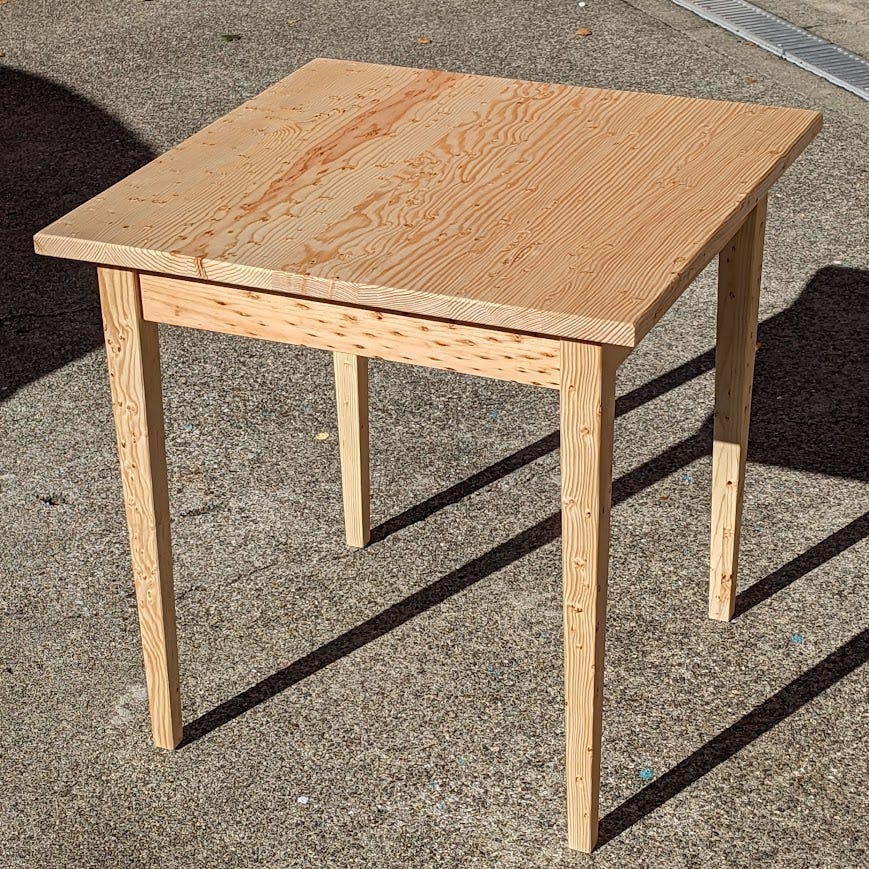
It does a disservice to try to make pine into something it’s not. (Walnut stain looks exceptionally weird.) It doesn’t need to be rare to be remarkable; it’s already doing the essential work of holding everything together. Once you start paying attention to it, you realize how much character it actually has. The knots, the contrast, the unpredictable grain, the subtle graying with age. It’s far from lacking beauty.
But most of the time, we don’t really pay attention. We walk past it, use it, and conceal it. We rely on it constantly without ever really seeing it for what it is. The more something is integrated in our lives, the more we take it for granted. None of us really noticed that “rustic” barroom wall until someone offhandedly asked the question. And then suddenly we were seeing it. Nothing changed but our attention. It’s worth taking time to refinish our perception of the pine in our lives.
And maybe not just the wood kind.